
Surgical Technology
Are you fascinated with the operating room and surgery? Consider becoming a surgical technologist.
The goal of the surgical technology program at GTCC is to prepare competent entry-level surgical technologists in the cognitive (knowledge), psychomotor (skills), and affective (behavior) learning domains to enter the profession.
The skills required to be a surgical technologist, according to the Association of Surgical Technologists, include:
- Preparing the operating room, including the sterile field, and setting up surgical equipment, supplies, and solutions
- Pass instruments, fluids, and supplies to the surgeon during surgery and prepare and manage surgical equipment
- Simultaneously manage the sterile field and specimens
- Perform a count of sponges and supplies to prevent foreign retained objects
Upon successful completion of the AAS Surgical Technology curriculum, graduates should be able to:
- Apply basic principles of anatomy, physiology, pathophysiology, and microbiology during the perioperative phases of patient care.
- Demonstrate knowledge of surgical technology skills by successfully accomplishing controlled learning activities.
- Practice responsible and accountable behavior within the role and competencies of the surgical technologist.
- Communicate professionally with all members of the perioperative team.
Upon completion of the surgical technology program at GTCC, graduates are eligible to take the National Certified Surgical Technologist (CST) examination administered by the National Board of Surgical Technology and Surgical Assisting.
The GTCC Surgical Technology program is accredited by the Commission on Accreditation of Allied Health Education Programs (CAAHEP) upon the recommendation of the Accreditation Review Council on Education in Surgical Technology and Surgical Assisting (ARC/STSA).
In November 2024, CAAHEP awarded continuing accreditation to the Surgical Technology Associate Degree program at Guilford Technical Community College in Jamestown, North Carolina. CAAHEP accreditation was awarded for the program's compliance with the Standards. The next comprehensive evaluation of the program, including a site visit, will be scheduled no later than 2034.

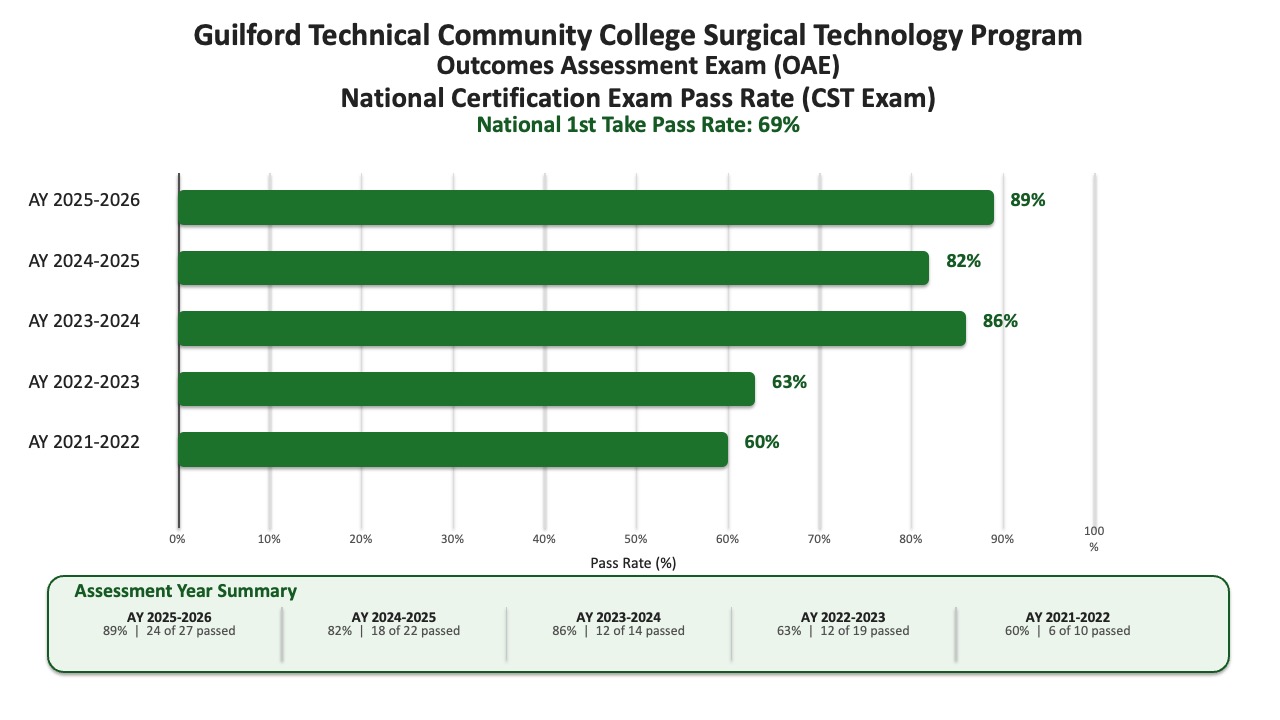
Outcomes Assessment Exam National Certification Exam Pass Rate (CST Exam): Assessment Year 2025-2026: 89%; 2024-2025: 82%; AY2023-2024: 85.6%; AY 2022-2023: 63%; AY 2021-2022: 63%
Admissions Information
- Program Facts [PDF]
- Program Technical Standards [PDF]
Credentialing Options
Frequently Asked Questions
The Surgical Technology program has a competitive admission process with a limited enrollment of 36 students for the Associate in Applied Science degree.
Students interested in applying for this program must follow the guidelines in the Surgical Technology Admission Packet linked above under the section called "Admission Information."
John Ratliff, MHA, CST, FAST
Program Director
Margaret Ortiz, BS, CST
Clinical Coordinator, Instructor
Accepted students will receive a letter acknowledging their acceptance into the program with additional information about an orientation session before the start of classes. At the orientation, students will receive information about health requirements, background/drug screening, clinical requirements, etc.
Students who are not accepted may want to apply for the next admission to the program. A Guided Entry Admission advisor can assist students with how to improve their ranking or choose another program to consider.
Students will begin having clinical experiences in area surgical centers and hospitals in the second semester of the program. They will spend 17 hours per week, two days a week, in the student role and are an integral part of the team of medical practitioners providing surgical care to patients under the supervision of agency staff and/or GTCC faculty.
| Expense Category | Estimated Cost |
|---|---|
| In-State Tuition, 66 credit hours | $4,422.00 |
| Out-of-State Tuition, 66 credit hours | $23,760.00 |
| Student Activity and Technology Fees | $400.00 |
| Textbooks and Supplies | $1,500.00 |
| Uniforms, Shoes, and ID Badges | $300.00 to $400.00 |
| CastleBranch Background Check | $125.00 to $130.00 |
| CPR Certification, if needed | $60.00 |
| Liability and Health Insurance | $70.00 |
| CST Exam, NBSTSA | $247.00 |
| Graduation Fee | $40.00 |
| My Clinical Exchange | $20.00 to $40.00 |
| Trajecsys Case Tracking | $100.00 |
| Estimated Total for In-State Students | $7,304.00 |
| Estimated Total for Out-of-State Students | $26,642.00 |
Note: Some costs are estimates and may vary based on vendor pricing, student needs, insurance status, textbook availability, and institutional fee changes.
Students who successfully complete the Associate in Applied Science degree are eligible to take the CST (Certified Surgical Technologist) exam. The certification, while not required by all healthcare agencies, may open additional employment opportunities for graduates.