
GTCC fire extension program director Thorpe uses his own experiences to help other firefighters
Published on: August 11, 2025
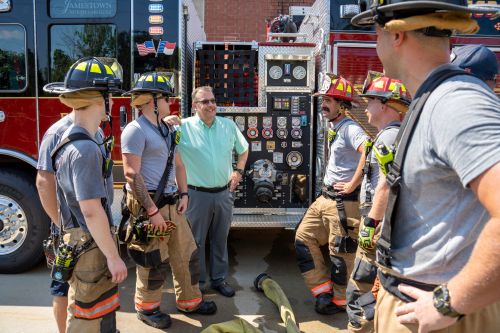
Matt Thorpe understands post-traumatic stress disorder and the impact it has on firefighters. It’s something he’s focused centrally on as his job as director of Guilford Technical Community College’s fire occupational extension program.
As a former firefighter who suffered from PTSD, his knowledge of the subject is firsthand.
“(Firefighting) is a ‘suck it up environment’ for sure. There is a stigma that prevents showing any weakness,” said Thorpe.
“At our fire academy, we have invited a peer support specialist to provide students with essential information and encourage them to talk about their feelings. Our faculty lets them know that our offices are always open, and we’ve had several students return to discuss their concerns with us.”
Thorpe has expanded his campaign to help firefighters understand and cope with daily stress by conducting formal research as part of his Master of Psychology program at Fayetteville State University. His recently approved study, “Bridging the Gap: Understanding Relationship Strain Among Firefighters and Their Spouses,” was presented to the North Carolina General Assembly last month.
“This kind of shows your work is paying off,” Thorpe said of the invitation to present his work to the general assembly. “I was tickled that they gave me that opportunity.”
Thorpe’s firefighting experience showed him how hard it was to compartmentalize workdays filled with both excitement and tragedy when returning home.
“We never prepare the spouses for what they can expect,” explained Thorpe. “When a firefighter comes off shift, they’ve seen things normal people don’t see. They come home and they are checked out. We don’t prepare spouses for that. If we did prepare them to recognize the signs of work-related stress, it could make a huge difference.
“(Mental health) is a huge boat we have been missing in the fire service. We have started looking at it a bit in the last five years and as someone who struggled with PTSD and depression, I wanted to look into it.”
It was actually a nudge from his wife that finally steered Thorpe toward obtaining his masters.
“My wife talked me into doing this and fortunately she’s fully supported me. It’s proven to be difficult for a lot of reasons. I finish work at 5:30 p.m. and then go home and work on papers. She hasn’t gotten on me too much on the weekends that I’ve been working on it.”
While his advanced studies have been booming, he’s maintained a 4.0 GPA and was recently named an outstanding graduate student for the College of Humanities and Social Sciences at Fayetteville State. At work, GTCC’s fire occupational extension program is booming, too! Enrollment in the program has grown significantly in the past couple of years, according to Thorpe.
“There are so many exciting things going on in our program at GTCC,” said Thorpe.
Thorpe may be back in the classroom again before long, all part of his goal of improving mental health conditions for firefighters.
“My next study is to find and vet mental health providers that understand what firefighters go through. They need to do ride-a-longs and see what it’s like first hand,” said Thorpe.
Back to All Articles